
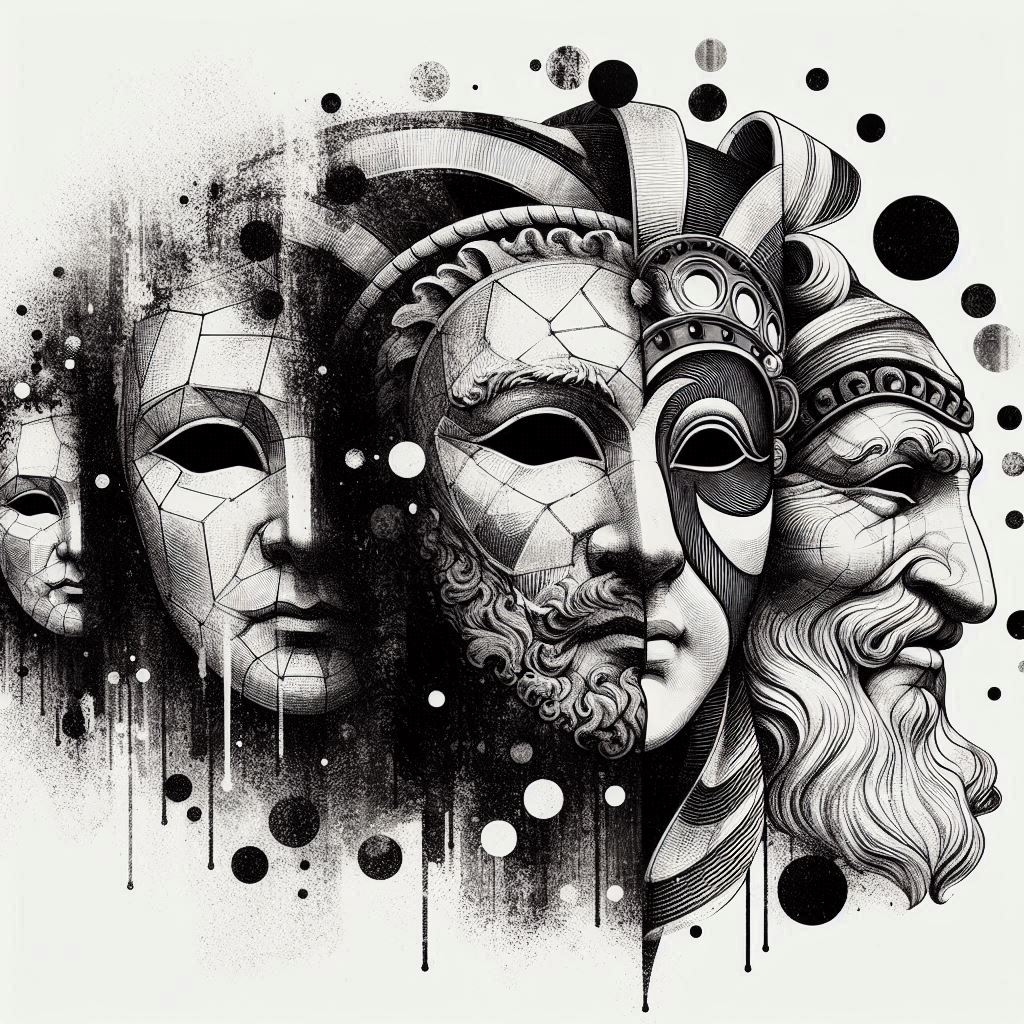

Throughout history, artists have grappled with fundamental questions of identity, authenticity, and the tension between our inner truth and external personas. From ancient theatrical to contemporary digital avatars, the exploration of “false self” versus “true self” has been a persistent theme in human creative expression. This article traces the evolution of these concepts through art, examining how different periods and mediums have confronted the complex relationship between conditioning, censorship, and authentic self-expression.
The Ancient Foundations: Masks and Performance
The earliest artistic explorations of identity can be traced to ancient theatrical traditions. Greek drama, with its elaborate masks and choruses, established the fundamental tension between public persona and private reality. The Greek concept of “persona” – literally meaning “mask” – would become central to Western understanding of identity performance.
In Sophocles’ “Oedipus Rex” (c. 429 BCE), the protagonist’s tragic journey exemplifies the collision between constructed identity and authentic truth. Oedipus begins as a confident king who has solved the Sphinx’s riddle, but his investigation into Laius’s murder systematically strips away his constructed identity. The dramatic irony – where the audience knows truths that Oedipus doesn’t – creates a powerful metaphor for self-deception and the false self. When Oedipus finally sees the truth, his self-blinding becomes a literal representation of preferring darkness to the painful light of authenticity.
Euripides’ “Medea” (431 BCE) presents a character whose authentic self – passionate, intelligent, foreign – conflicts with Greek social expectations for women. Medea’s famous monologue where she debates whether to kill her children reveals the internal dialogue between her role as mother (socially constructed) and her authentic fury and desire for revenge. The physical masks worn by actors became metaphors for the psychological masks we wear in daily life.
The Roman concept of “larvatus prodeo” – “I advance masked” – captured the notion that all social interaction involves a degree of performance and concealment. This phrase, later adopted by René Descartes, acknowledged that philosophical and artistic truth-seeking often requires protective disguise in the face of social or political pressure.
Medieval Allegory and the Divided Self
Medieval art introduced more sophisticated explorations of internal conflict through allegory. Guillaume de Lorris and Jean de Meun’s “Roman de la Rose” (13th century) presents the self as a battleground between competing forces – reason, passion, virtue, and vice. The poem’s allegorical characters like Bel Accueil (Fair Welcome) and Dangier (Resistance) externalize the internal psychological conflicts surrounding authentic desire versus social propriety. The Rose itself becomes a symbol of the authentic self that must be pursued despite external obstacles and internal contradictions.
The morality plays of the late medieval period, such as “Everyman” (c. 1510), externalized internal psychological states through personified characters. In this play, characters like Fellowship, Cousin, and Goods abandon Everyman when he faces death, while only Good Deeds remains faithful. This allegorical structure explores how external relationships and social roles fail to provide authentic meaning in the face of ultimate reality. The play’s exploration of which aspects of identity persist beyond social death prefigures later psychological investigations into the true versus false self.
Dante’s “Divine Comedy” (1320) presents perhaps the most comprehensive medieval exploration of authentic selfhood. Dante-the-pilgrim begins lost in a dark wood, symbolic of spiritual and psychological confusion. His journey through Hell, Purgatory, and Paradise represents the process of stripping away false identities and social conditioning to achieve authentic spiritual realization. The character of Beatrice, transforming from earthly love object to spiritual guide, embodies the evolution from socially constructed desire to authentic spiritual truth.

Renaissance Portraits: The Birth of Psychological Realism
The Renaissance marked a crucial shift toward psychological interiority in art. Leonardo da Vinci’s “Mona Lisa” (1503-1519) revolutionized portraiture by suggesting hidden depths beneath the surface. Her enigmatic smile became an icon of the unknowable inner self, the gap between external presentation and internal reality. The painting’s sfumato technique – subtle gradations of tone without harsh outlines – mirrors the ambiguous boundaries between authentic and performed identity. Giorgio Vasari’s description of the painting notes how Leonardo captured “a thing more divine than human,” suggesting that authentic selfhood transcends social categorization.
Albrecht Dürer’s self-portraits, particularly his “Self-Portrait at Twenty-Eight” (1500), explored the relationship between artistic identity and authentic selfhood. By depicting himself in a Christ-like pose with penetrating gaze and frontal composition typically reserved for religious icons, Dürer questioned the boundaries between sacred and secular identity, between the artist’s social role and personal truth. The inscription “I, Albrecht Dürer of Nuremberg, portrayed myself in everlasting colors aged twenty-eight years” asserts the permanence of authentic self-representation against the transience of social roles.
Parmigianino’s “Self-Portrait in a Convex Mirror” (1524) presents a distorted self-image that questions the reliability of self-perception. The curved mirror creates a fish-eye effect that enlarges the artist’s hand while diminishing his face, suggesting that our self-understanding is always mediated by external instruments and perspectives. This work prefigures postmodern concerns about the impossibility of unmediated self-knowledge.
Shakespeare’s characters, especially in “Hamlet” (1600-1601), embodied the Renaissance fascination with authentic versus performed identity. Hamlet’s famous soliloquy “To be or not to be” explores the gap between authentic existence and social performance. His instruction to “be true to thine own self” occurs in a context where authentic self-expression could prove fatal, establishing the central tension between authenticity and survival that would dominate later artistic explorations. The play-within-a-play device literalizes the theme of performed versus authentic identity, as Hamlet uses theatrical performance to reveal authentic truth about his father’s murder.
Baroque Drama and the Theater of Power
The Baroque period intensified explorations of identity through dramatic tension and psychological complexity. Caravaggio’s paintings, with their stark chiaroscuro lighting, revealed the dual nature of human character – simultaneously saint and sinner, authentic and deceptive. His “The Calling of Saint Matthew” (1599-1600) captures the moment of spiritual transformation, when Matthew’s external identity as tax collector conflicts with his emerging authentic spiritual calling. The dramatic lighting literally illuminates this internal conflict, with divine light penetrating the shadowy tavern world of social convention.
Caravaggio’s “Narcissus” (1597-1599) presents a more troubling vision of self-reflection, where the protagonist falls in love with his own reflection – a false image that ultimately destroys him. This painting prefigures later psychological insights about the dangers of constructing identity based on external validation rather than internal truth.
Pedro Calderón de la Barca’s “Life is a Dream” (1635) presented reality itself as uncertain, questioning whether our perceived identities are merely illusions. The play’s central character, Segismundo, struggles to distinguish between his authentic self and the roles imposed upon him by circumstance and authority. His famous soliloquy “What is life? A madness. What is life? An illusion, a shadow, a story” articulates the baroque anxiety about the substantial reality of identity itself.
The period’s fascination with trompe-l’oeil painting techniques created visual metaphors for the deceptive nature of appearances. Andrea Pozzo’s “Allegory of the Missionary Work of the Jesuits” (1691-1694) on the ceiling of Sant’Ignazio in Rome creates the illusion of architectural depth on a flat surface, requiring viewers to question the reliability of their own perceptions – a perfect metaphor for the baroque exploration of authentic versus deceptive identity.
Romantic Rebellion: The Authentic Self Emerges
The Romantic movement marked a decisive turn toward prioritizing individual authenticity over social conformity. Caspar David Friedrich’s “Wanderer above the Sea of Fog” (1818) became an icon of the individual seeking authentic connection with nature and self, away from society’s corrupting influence. The lone figure, viewed from behind, invites viewers to identify with the search for authentic selfhood through direct experience rather than social mediation. Friedrich’s “Monk by the Sea” (1809) presents an even more radical vision of authentic solitude, where the tiny human figure confronts the sublime without any social context or support.
Lord Byron’s poetry, particularly “Childe Harold’s Pilgrimage” (1812-1818), explored the tension between public persona and private torment. Byron’s famous line “I have not loved the world, nor the world me” articulates the Romantic conviction that authentic selfhood often requires rejection of social convention. Byron himself became a prototype of the authentic artist struggling against social convention, his scandalous reputation paradoxically enhancing his credibility as someone who refused to wear society’s mask.
Percy Bysshe Shelley’s “Ozymandias” (1818) presents a meditation on the ultimate authenticity of the individual versus the false permanence of social power. The poem’s description of the ruined statue – “Look on my works, ye Mighty, and despair!” – surrounded by “lone and level sands” suggests that authentic human achievement transcends the constructed monuments of social authority.
Francisco Goya’s “Black Paintings” (1819-1823), created in isolation during his illness, represented perhaps the first major artistic exploration of unfiltered psychological states. Works like “Saturn Devouring His Son” revealed the artist’s internal landscape without concern for public reception or social acceptability. These paintings, created directly on the walls of his house, were never intended for public viewing, making them perhaps the purest expression of authentic artistic vision uncompromised by social considerations.
Goya’s “The Sleep of Reason Produces Monsters” (1799) from his “Caprichos” series literalizes the Romantic concern that rational, socially acceptable consciousness suppresses authentic but disturbing psychological truths. The image of the sleeping figure surrounded by nightmarish creatures suggests that authentic selfhood includes acknowledging our shadow aspects.

Victorian Anxieties: The Double Life
The Victorian era, with its rigid social codes, generated intense artistic interest in the gap between public respectability and private reality. Robert Louis Stevenson’s “The Strange Case of Dr. Jekyll and Mr. Hyde” (1886) became the definitive exploration of the divided self, literalizing the concept of the false self as a separate entity. Jekyll’s transformation into Hyde represents the Victorian anxiety that authentic impulses, when suppressed by social convention, become monstrous and destructive. The novella’s popularity reflected widespread recognition of the psychological cost of Victorian propriety.
Oscar Wilde’s “The Picture of Dorian Gray” (1890) examined how the desire to maintain a perfect external appearance corrupts the inner self. Dorian’s portrait, hidden away and growing increasingly grotesque while his physical appearance remains beautiful, became a powerful metaphor for the false self that preserves social acceptability while the authentic self deteriorates. Wilde’s own life – torn between public respectability and private authenticity as a homosexual man in Victorian society – embodied the era’s struggle with identity performance. His famous declaration “I can resist everything except temptation” captures the Victorian tension between authentic desire and social expectation.
Charlotte Brontë’s “Jane Eyre” (1847) explored female authenticity in a society that demanded women’s self-effacement. Jane’s famous declaration “I am no bird; and no net ensnares me: I am a free human being with an independent will” articulates the struggle for authentic selfhood against social conditioning. The novel’s Gothic elements – the mad woman in the attic, the mysterious fires, the telepathic connection between Jane and Rochester – externalize the psychological violence of suppressing authentic female identity.
The Pre-Raphaelites, particularly Dante Gabriel Rossetti, explored themes of authentic versus socially acceptable desire through their revival of medieval romanticism. Rossetti’s “Lady Lilith” (1866-1868) presents a figure of dangerous female authenticity, combing her hair in narcissistic self-absorption, refusing the Victorian ideal of self-sacrificing womanhood. His “Proserpine” (1877) depicts a figure trapped between two worlds – the underworld of authentic desire and the surface world of social acceptability.
Christina Rossetti’s poem “Goblin Market” (1862) uses fairy tale allegory to explore the consequences of authentic desire in a repressive society. The poem’s imagery of forbidden fruit and sisterly redemption suggests that authentic selfhood requires both individual courage and community support to survive social censure.
Modern Fragmentation: The Fractured Self
The 20th century shattered traditional notions of unified identity. Picasso’s “Les Demoiselles d’Avignon” and subsequent Cubist works literally fragmented the human form, suggesting that identity itself might be multifaceted and non-linear.
James Joyce’s “Ulysses” pioneered stream-of-consciousness technique, revealing the chaotic, unfiltered nature of internal experience. Leopold Bloom’s interior monologue contrasted sharply with his external behavior, illustrating the gap between inner and outer life.
T.S. Eliot’s “The Love Song of J. Alfred Prufrock” captured the modern anxiety of self-presentation: “I have measured out my life with coffee spoons” and “I have heard the mermaids singing, each to each. I do not think that they will sing to me.” Prufrock’s paralysis stems from his acute awareness of performing identity rather than living it.
Surrealism and the Unconscious Self
The Surrealist movement, influenced by Freudian psychoanalysis, sought to bypass the conscious mind’s censorship mechanisms. Salvador Dalí’s “The Persistence of Memory” and René Magritte’s “The Treachery of Images” explored how perception itself might be a form of false consciousness.
Max Ernst’s collages and André Breton’s automatic writing techniques attempted to access the “true” unconscious self by circumventing rational, socially conditioned thought processes. These artists viewed the unconscious as more authentic than conscious, socially constructed identity.
Existentialist Authenticity: The Burden of Freedom
Post-war existentialist philosophy profoundly influenced artistic explorations of authenticity. Jean-Paul Sartre’s concept of “bad faith” – the denial of our fundamental freedom to choose our identity – became a central theme in mid-century art.
Francis Bacon’s distorted figures, particularly his screaming popes and isolated businessmen, visualized the anguish of authentic existence in a world of social roles and expectations. His paintings suggested that beneath the veneer of civilized behavior lies a more primitive, authentic self.
Alberto Giacometti’s elongated sculptures captured the existential isolation of the individual struggling to maintain authentic identity in mass society. His figures appear to be dissolving or struggling to maintain their form, metaphorically representing the difficulty of preserving authentic selfhood.
Abstract Expressionism: Pure Emotional Truth
The Abstract Expressionists sought to eliminate representational content that might dilute authentic emotional expression. Jackson Pollock’s action paintings were intended as direct manifestations of the artist’s inner state, bypassing conscious control and social conditioning.
Mark Rothko’s color field paintings aimed to evoke direct emotional responses, creating what he called “intimate and human” encounters between artwork and viewer. Rothko viewed his work as revealing universal truths about human experience, unmediated by cultural or social filters.

Pop Art and the Commodified Self
The Pop Art movement of the 1960s critically examined how mass media and consumer culture shape identity. Andy Warhol’s celebrity portraits, particularly his Marilyn Monroe series, explored how public figures become commodified images disconnected from their authentic selves.
Roy Lichtenstein’s comic book paintings suggested that even our most intimate emotions might be mediated by mass media templates. His work questioned whether authentic feeling was possible in a culture saturated with manufactured images and narratives.
Performance Art and Identity Politics
Performance art emerged as a medium uniquely suited to exploring identity construction and authenticity. Marina Abramović’s endurance pieces, such as “The Artist is Present,” stripped away all pretense, presenting the artist’s authentic physical and emotional state in real-time.
Cindy Sherman’s “Untitled Film Stills” deconstructed female identity by showing how it’s constructed through media representation. Sherman’s work suggested that the “true self” might be an illusion, that we are always performing roles derived from cultural sources.
Contemporary Digital Identity
The digital age has intensified questions about authentic versus performed identity. Social media platforms create unprecedented opportunities for identity curation and performance, leading to new forms of artistic exploration.
Artists like Amalia Ulman have used Instagram as a medium for performance art, creating fictional online personas that critique the platform’s emphasis on lifestyle performance. Her work “Excellences & Perfections” demonstrated how social media encourages the construction of false selves optimized for public consumption.
Therapeutic and Psychological Frameworks
Contemporary art increasingly draws on psychological frameworks to explore identity construction. The concept of “false self,” coined by psychoanalyst Donald Winnicott, suggests that individuals develop protective personas to cope with environmental pressures, potentially losing touch with their authentic core.
Artists like Louise Bourgeois explored trauma and its impact on identity formation. Her spider sculptures and cell installations created environments where visitors could confront their own psychological defenses and potentially access more authentic emotional states.
Intersectional Identity and Authenticity
Contemporary artists from marginalized communities have expanded traditional notions of authenticity to include intersectional identity. Kerry James Marshall’s paintings explore how African American identity is constructed both internally and through external social forces.
Kara Walker’s silhouette installations examine how historical narratives shape contemporary identity, particularly for those whose authentic experiences have been suppressed or distorted by dominant cultural narratives.

The Therapeutic Turn in Contemporary Art
Many contemporary artists approach their work as a form of therapy, using art-making to explore and potentially resolve identity conflicts. Tracey Emin’s confessional installations and Nan Goldin’s intimate photography document the artists’ searches for authentic self-expression despite trauma and social pressure.
This therapeutic approach to art-making reflects broader cultural shifts toward valuing emotional authenticity and psychological well-being over social conformity.
Digital Age Anxieties
The internet era has created new forms of identity performance and authenticity anxiety. Artists like Zach Blas explore how digital surveillance and data collection create new forms of social pressure and self-censorship.
The phenomenon of “Instagram vs. Reality” has spawned artistic responses examining how social media platforms encourage the construction of idealized false selves. Artists use these platforms both to critique and to explore new forms of authentic self-expression.
Global Perspectives on Authenticity
Contemporary art has become increasingly global, incorporating diverse cultural perspectives on authenticity and identity. Artists from non-Western traditions offer alternative frameworks for understanding the relationship between individual truth and social belonging.
Chinese artist Ai Weiwei’s work explores how political censorship forces individuals to develop sophisticated strategies for authentic expression within oppressive systems. His art demonstrates how external censorship can generate internal conflicts between safety and authenticity.
The Continuing Evolution
The artistic exploration of false versus true self continues to evolve as new technologies and social conditions create novel forms of identity performance and authenticity anxiety. Virtual reality, artificial intelligence, and biotechnology promise to generate new artistic investigations into what constitutes authentic human experience.
As we navigate an increasingly complex media landscape, artists continue to serve as crucial investigators of identity, helping us understand how external pressures shape internal experience and how authentic self-expression might be possible despite these constraints.

Conclusion
The thread connecting ancient Greek masks to contemporary digital avatars reveals a persistent human need to understand and express our authentic selves while navigating social expectations and external pressures. Art remains our most powerful tool for exploring these eternal questions, offering both mirrors for self-reflection and windows into alternative possibilities for authentic existence.
Through their willingness to expose vulnerability, challenge conventions, and explore uncomfortable truths, artists continue to model pathways toward greater authenticity, even as they document the obstacles that make such authenticity perpetually challenging to achieve.
References and Further Reading
Ancient Sources:
- Sophocles. Oedipus Rex (c. 429 BCE). Available at: https://classics.mit.edu/Sophocles/oedipus.html
- Euripides. Medea (431 BCE). Available at: https://classics.mit.edu/Euripides/medea.html
Medieval Sources:
- Guillaume de Lorris and Jean de Meun. Roman de la Rose (13th century). Available at: https://www.poetryintranslation.com/PITBR/French/Rose.php
- Everyman (c. 1510). Available at: https://www.gutenberg.org/files/1581/1581-h/1581-h.htm
- Dante Alighieri. Divine Comedy (1320). Available at: https://digitaldante.columbia.edu/
Renaissance Sources:
- Leonardo da Vinci. Mona Lisa (1503-1519). Louvre Museum: https://www.louvre.fr/en/oeuvre-notices/mona-lisa-portrait-lisa-gherardini-wife-francesco-del-giocondo
- Dürer, Albrecht. Self-Portrait at Twenty-Eight (1500). Alte Pinakothek: https://www.sammlung.pinakothek.de/en/artwork/mGPNAV0E5g
- Shakespeare, William. Hamlet (1600-1601). Available at: https://www.gutenberg.org/files/1524/1524-h/1524-h.htm
Baroque Sources:
- Caravaggio. The Calling of Saint Matthew (1599-1600). San Luigi dei Francesi: https://www.caravaggio.org/the-calling-of-saint-matthew.jsp
- Calderón de la Barca, Pedro. Life is a Dream (1635). Available at: https://www.gutenberg.org/files/2721/2721-h/2721-h.htm
Romantic Sources:
- Friedrich, Caspar David. Wanderer above the Sea of Fog (1818). Kunsthalle Hamburg: https://www.hamburger-kunsthalle.de/en/collection/wanderer-above-the-sea-of-fog
- Byron, Lord. Childe Harold’s Pilgrimage (1812-1818). Available at: https://www.gutenberg.org/files/5131/5131-h/5131-h.htm
- Goya, Francisco. Black Paintings (1819-1823). Museo del Prado: https://www.museodelprado.es/en/the-collection/art-work/witches-sabbath-or-the-great-he-goat-one-of-the/9ba4b9bb-00e3-47f9-9b1a-f9d8b8e2e6c8
Victorian Sources:
- Stevenson, Robert Louis. The Strange Case of Dr. Jekyll and Mr. Hyde (1886). Available at: https://www.gutenberg.org/files/43/43-h/43-h.htm
- Wilde, Oscar. The Picture of Dorian Gray (1890). Available at: https://www.gutenberg.org/files/174/174-h/174-h.htm
- Brontë, Charlotte. Jane Eyre (1847). Available at: https://www.gutenberg.org/files/1260/1260-h/1260-h.htm
Modern Sources:
- Picasso, Pablo. Les Demoiselles d’Avignon (1907). MoMA: https://www.moma.org/collection/works/79766
- Joyce, James. Ulysses (1922). Available at: https://www.gutenberg.org/files/4300/4300-h/4300-h.htm
- Eliot, T.S. The Love Song of J. Alfred Prufrock (1915). Available at: https://www.poetryfoundation.org/poetrymagazine/poems/44212/the-love-song-of-j-alfred-prufrock
Contemporary Sources:
- Abramović, Marina. The Artist is Present (2010). MoMA: https://www.moma.org/calendar/exhibitions/965
- Sherman, Cindy. Untitled Film Stills (1977-1980). MoMA: https://www.moma.org/collection/works/56618
- Ulman, Amalia. Excellences & Perfections (2014). Available at: https://www.frieze.com/article/amalia-ulman
Academic Sources:
- Winnicott, Donald. “Ego Distortion in Terms of True and False Self.” The Maturational Processes and the Facilitating Environment (1965)
- Goffman, Erving. The Presentation of Self in Everyday Life (1956)
- Butler, Judith. Gender Trouble: Feminism and the Subversion of Identity (1990)
- Foucault, Michel. The Care of the Self: Volume 3 of The History of Sexuality (1986)
 English