

Have you ever noticed that arguing with a seven-year-old is like trying to win a case in a courtroom where the judge is eating a crayon and the only evidence allowed is “Because I said so”?
One minute you’re discussing why shoes belong in the cubby, and the next, you’re being hit with a sophisticated Ad Hominem attack about your “weird hair”. You didn’t lose the argument because you were wrong; you lost because your child is a natural-born rhetorical ninja who hasn’t been taught to use their powers for good.
In an age of endless scrolling, viral unboxing videos, and sophisticated advertising, our kids are being “hacked” by professional persuaders. Research shows that 82% of middle school students cannot distinguish between a real news story and a paid advertisement. They are operating on “System 1” thinking—fast, emotional, and easily manipulated.
It’s time to give them Mental Immunity.
The Architecture of a “Thinking Trap”
We often dismiss child logic as “stubbornness,” but it’s actually a series of predictable cognitive errors. When your child refuses to stop watching a movie they hate because “we already paid for the rental,” they aren’t being difficult; they are stuck in the Sunk Cost Fallacy. When they decide all dogs are monsters because one barked at them, they are committing a Hasty Generalization.
These aren’t just “phases.” If kids don’t learn to identify these “Thinking Traps” early, they grow into adults who are easily swayed by propaganda and statistical errors.
The Top 5 Logic Fails in Every Household
According to our research into logic pedagogy, these are the most common fallacies kids (and let’s be honest, parents) use daily:
-
The Bandwagon Effect: “Everyone else has light-up sneakers!” This assumes popularity equals truth.
-
Tu Quoque (The “You Too” Trap): “You didn’t clean your room this morning, so I don’t have to!” This uses hypocrisy to deflect a valid point.
-
The Slippery Slope: “If I eat one pea, I’ll have to become a vegetarian, and then I’ll never have joy again!”.
-
Circular Reasoning: “I’m the boss because I’m in charge.” The conclusion is tucked inside the premise.
-
Confirmation Bias: Only hearing the word “cookie” from three rooms away while ignoring the word “homework” from three feet away.
Turning “Bitey Alligators” into Logic Detectives
Raising a child is often compared to finding a baby alligator and putting it in your tub—eventually, those “little bitey teeth” become a problem. Critical thinking is the manual for taming that alligator.
Teaching logic to children as young as five to seven isn’t about dry textbooks; it’s about “bottom-up” learning through humor and relatable stories. By turning your child into a Logic Detective, you move them from impulsive reactions to deliberative, “System 2” thinking.
The benefits go beyond winning debates. Research indicates that children with strong critical thinking skills perform better in language comprehension, have higher self-discipline, and are more resilient against “cancel culture” and social manipulation.
The Launch of Logical Fallacies for Kids
If you’re tired of the “Circular Bedtime Paradox” and want to equip your child with a “Baloney Detection Kit,” the wait is over.
Our new resource, Logical Fallacies for Kids, is officially live. It covers 50 common reasoning errors using custom illustrations and “ridiculous examples” that make kids want to learn. From the Dunning-Kruger Effect (the confidence of the completely uninformed) to the Rhyme-as-Reason Effect, this book turns complex psychology into a secret code for your family.
Why This Matters Now
In the “Second Machine Age,” AI-driven algorithms dictate what our kids see based on “emotional contagion”. Critical thinking is no longer a “bonus” skill; it is a survival tool for navigating a world of misinformation.
Stop the “System 1” hijack today.
-
Learn more at the official site
-
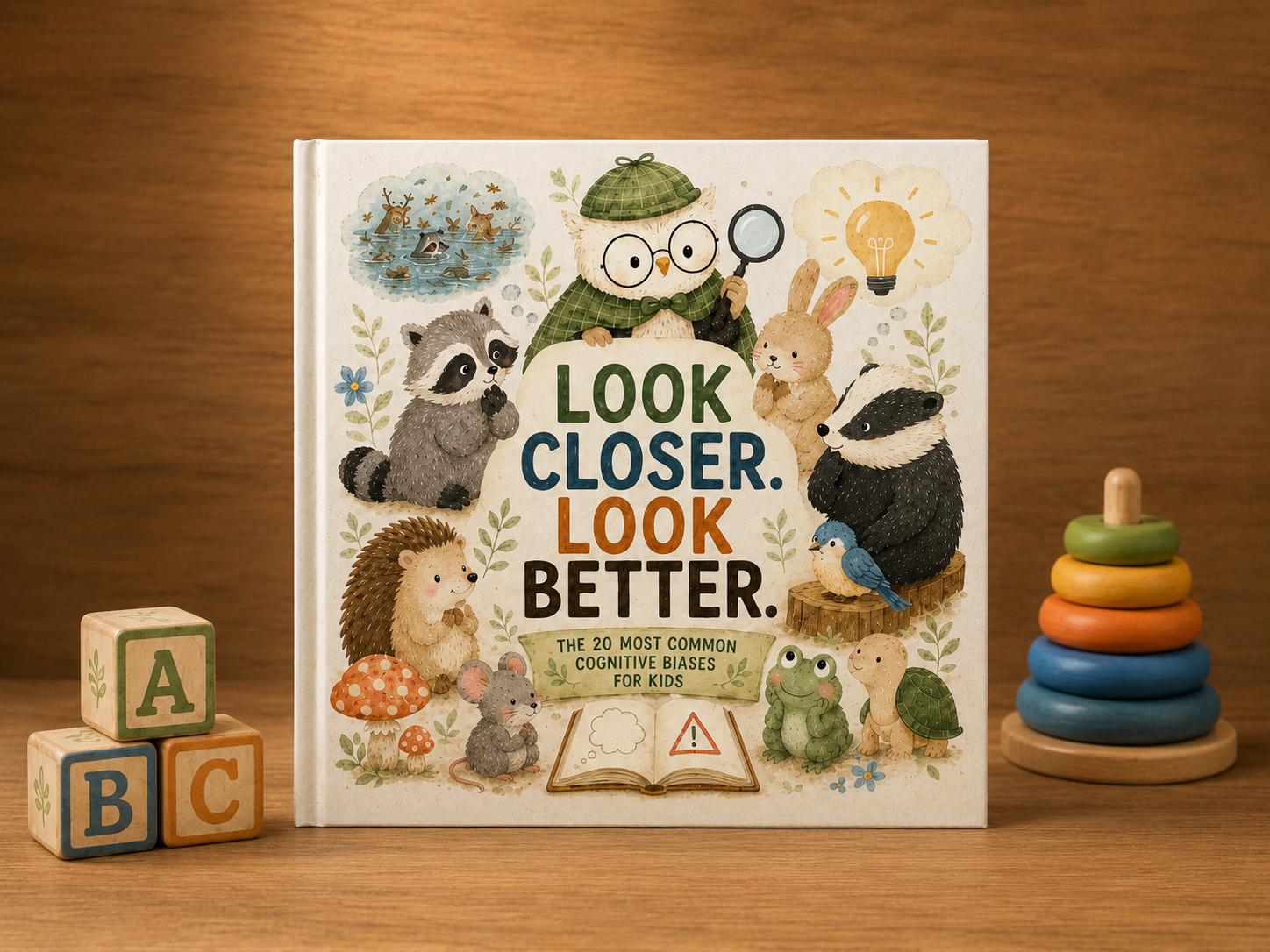
Grab your copy on Amazon: LOOK CLOSER. LOOK BETTER: The 20 most common cognitive biases – for Kids
Give your child the gift of a sharp mind. Because a kid who can spot a Red Herring is a kid who can never be fooled.

 English